
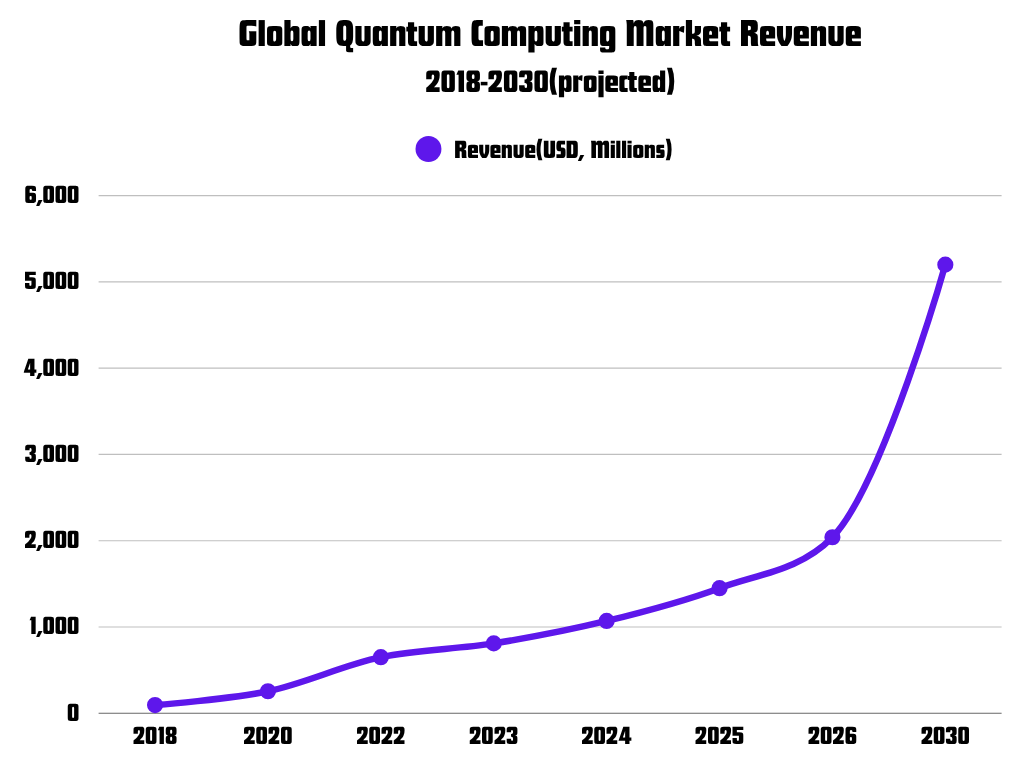
In 2024, the quantum technology industry reached a significant milestone, generating more than $1.45 billion in global revenue. While classical computers—like your smartphone or laptop—rely on binary bits (0 or 1), quantum computing utilizes the principles of quantum mechanics to process information in a fundamentally different way. With accelerating investment in this field, projections from McKinsey and the World Economic Forum suggest that the total economic value of quantum technology could reach $100 billion by the mid-2030s.
What Is Quantum Computing?
The foundation of this technology is the qubit. Unlike a classical bit, which is limited to a single state of either 0 or 1 at any given time, a qubit can exist in a state of superposition, representing both 0 and 1 simultaneously. This allows quantum systems to perform parallel computations on a scale impossible for binary systems.
This processing power is enhanced by entanglement, a phenomenon where the state of one qubit is linked to another, enabling coordinated data processing across the entire system. Because of these unique mechanics, Quantum Technology (QT) is categorized into three primary sectors:
- Quantum Computing: Focuses on solving complex optimization and simulation problems.
- Quantum Communication: Utilizes quantum states for secure, tamper-evident data transmission.
- Quantum Sensing: Used to make high-precision measurements of gravitational, magnetic, and electric fields.
By 2035, these combined sectors are projected to reach over $97 billion in revenue, with quantum computing accounting for about 74% of that.
What Industries Will Quantum Computing Affect?
While quantum computing is projected to affect nearly every sector in the future, there are four fields that will be particularly transformed:
1. Life Sciences and Drug Discovery
Developing a new pharmaceutical can cost between $1 to $2.5 billion and the process usually takes 10 to 15 years, largely due to the massive difficulty of simulating molecular interactions. Quantum computers can model these interactions from first principles, potentially halving research and development timelines. Early applications have already focused on simulating KRAS proteins, which are critical in cancer research.
2. Financial Services and Cryptography
Financial institutions are already deploying quantum algorithms for risk assessment and portfolio optimization. However, the most immediate economic concern is the vulnerability of RSA and ECC encryption. Because quantum computers can theoretically solve the large-number factorization problems that secure modern digital infrastructure, the industry is transitioning toward Post-Quantum Cryptography (PQC). The U.S. National Institute of Standards and Technology (NIST) finalized its first PQC standards in 2024 to mitigate this risk.
3. Materials Science and Energy Storage
The transition to electric vehicles (EVs) is currently restricted by the energy density of lithium-ion batteries. Quantum simulations allow researchers to analyze electron behavior in chemical compounds, accelerating the development of solid-state and lithium-sulfur batteries that are key to the development of electric vehicles.
4. Logistics and Supply Chain Optimization
Supply chain management relies on combinatorial optimization — finding the most efficient path among billions of variables. Quantum hardware, such as D-Wave’s annealing systems, has already demonstrated the ability to reduce industrial scheduling tasks from 30 minutes to under five minutes in live production environments.
What Are The Risks Of Quantum Computing?
Despite the massive upside, the deployment of quantum technology faces significant logistical and security hurdles:
- Decoherence and Error Correction: Qubits are highly sensitive to environmental noise, like heat and radiation. Many systems require operational temperatures near absolute zero (−273°C). Consequently, the industry shifted in 2024 from simply increasing qubit counts to improving error correction and hardware stability.
- Cybersecurity Latency: A major risk is the “harvest now, decrypt later” tactic, where entities collect encrypted data today with the intent of decrypting it once fault-tolerant quantum computers become available.
- Geopolitical Concentration: Access to quantum hardware is now a matter of national strategy. Heavy public investment in the U.S., China, and the EU has created a competitive race for quantum advantage — the point at which a quantum machine outperforms the best classical supercomputer.
Deployment Timeline
The United Nations has designated 2025 as the International Year of Quantum Science and Technology, marking the transition from lab-based experimentation to industrial infrastructure. While the technology is not yet a total replacement for classical computing, it is increasingly used as a specialized accelerator for critical problems in medicine, finance, and logistics.
The Takeaway
Quantum computing is transitioning from a theoretical technology to an economic driver. While hardware fragility and the need for new encryption standards present challenges, the projected growth suggests it will become a core component of the global technological infrastructure. Ultimately, the economic impact won’t come from a total replacement of current systems, but from the ability to solve specific optimization and simulation problems that have remained impossible for binary computers to solve for decades.